Periodontal care in Downtown Brooklyn
Gum disease needs a specialist team.
Bleeding, tender, or receding gums, or a dentist who's mentioned deep pockets or gum disease, are signs you need more than a regular cleaning. Our three full-time registered hygienists work only on gums and dental implants, alongside periodontists Dr. Brian Choi and Dr. Michael Zidile. No referral needed, and you keep your own dentist.
More questions patients ask
What is the difference between a regular cleaning and periodontal care?
A regular cleaning is preventive care for healthy gums, usually twice a year. Periodontal care is treatment for gums that already have disease or bone loss: every site is measured, buildup is removed below the gumline to the depth of each pocket, and visits are spaced by what your gums need, often every 3 to 4 months.
| Comparison | Regular dental cleaning | Periodontal care at Brooklyn Periodontics |
|---|---|---|
| Who it's for | Healthy gums with no bone loss | Gum disease, bone loss, bleeding or receding gums, and dental implants |
| Who provides it | Your general dentist's team | Registered hygienists in a periodontal practice, with periodontists on the same team |
| What's measured | A routine look at teeth and gums | Every site measured to track your gums over time, with X-rays as needed |
| Where it focuses | Above and just below the gumline | Below the gumline, to the depth of each pocket, and around implants |
| How it's done | Standard instruments | Gentle air-and-water spray, careful removal of buildup, and microscopic plaque sampling |
| How often | Typically twice a year | Usually every 3 to 4 months, adjusted to your measurements |
| The goal | Prevent problems in a healthy mouth | Stop gum disease and keep it under control |
Both matter. Your general dentist remains your home base for routine dental care; periodontal care is for gums that need more.
More on periodontal maintenanceWhat are the signs of gum disease?
The most common signs are gums that bleed when you brush or floss, bad breath or a bad taste that won't go away, gums pulling back from your teeth, and teeth that feel loose or have shifted. Gum disease is usually painless until it is advanced, so bleeding gums are worth having checked.
- Gums that bleed when you brush or floss
- Persistent bad breath or a bad taste
- Gums pulling away from your teeth, or teeth that look longer
- Loose or shifting teeth
- Your dentist mentioned deep pockets or bone loss
- An implant that feels sore, bleeds, or looks different
More about periodontal care
Your visit is with one of our three full-time registered hygienists, who work only on gums and dental implants, in a periodontal practice with Dr. Choi and Dr. Zidile on the same team. Every site is measured to track your gums over time, your plaque can be checked under a microscope with you, and a gentle air-and-water spray removes the bacteria behind gum disease.
3 full-time registered hygienists
A dedicated team focused only on gum and implant health, not a general practice schedule.
Gentle air-and-water therapy
A warm spray removes the bacterial film that drives gum disease and implant infection. Comfortable and precise.
Microscopic plaque sampling
When useful, we sample plaque and review it with you under the microscope, so care matches the bacteria that are actually there.
Visit spacing set by your gums
Three months is a common starting point for gum disease management. If measurements stay stable, the interval can lengthen. If not, we shorten it and find out why.
In a periodontal practice
Care happens here, with Dr. Choi and Dr. Zidile on the same team when a site needs more than therapy alone.
A periodontal care visit has four steps: we measure your gums, look at your plaque under a microscope together, gently clean above and below the gumline, and plan your next visit and home care with you.
We measure your gums
Your hygienist gently measures the gum around every tooth and implant, notes any bleeding or gum pulling back, and tracks the numbers over time so you can see change. X-rays are taken if needed, especially around implants and areas treated before. You'll see where your gums are healthy and where they need attention.
We look at your plaque under a microscope together
When it's useful, we take a small sample of plaque from the gumline and look at it under the microscope with you. You see the bacteria we're treating, and it helps us match your care and home routine to what's actually there.
We gently clean above and below the gumline
A warm air-and-water spray lifts the bacterial film off your teeth, roots, and implants. Then any remaining buildup is carefully removed, above and below the gumline, to the depth of each pocket. If an area is sensitive, we numb it first so you stay comfortable.
We plan your next visit and home care together
We set your next visit based on today's measurements, often 3 to 4 months out, and show you the home-care tools that fit your mouth, such as interdental brushes sized to your spaces, a water flosser, or implant-specific aids. If you also see a general dentist, we coordinate the schedule with them.
Usually not. The air-and-water spray is gentle, and we numb any area that is sensitive. After deeper therapy, gums can feel tender for a few days.
Most patients come every 3 to 4 months. The interval is set by your gum measurements: if they stay stable it can lengthen, and if they don't, we shorten it and find out why.
Tender gums and some sensitivity to hot or cold are normal for the first day or two, and lukewarm foods and a soft toothbrush help. Over the first week your gums calm down and feel firmer, and about six to eight weeks later we re-measure the same sites to check the result.
- Day 0 – 1
Tender gums and some sensitivity to hot or cold are normal. Lukewarm foods and a soft toothbrush help.
- Days 2 – 3
Sensitivity may linger a little. Keep brushing gently and cleaning between your teeth, even if the gums are a bit tender.
- Week 1 and beyond
Tissues calm down and feel firmer. Keep up your home care and come back for your re-evaluation or maintenance visit as instructed.
Call or text (718) 643-1953 right away if you have severe pain, heavy or continuous bleeding, fever or chills, or swelling in your face.
Send an after-therapy check-inBrush gently, clean between your teeth every day, and use the tools your hygienist picks for your mouth, such as interdental brushes sized to your spaces, a water flosser, or implant-specific aids. At each visit we check how it's working and adjust.
Yes. Implants can develop infection and bone loss around them, called peri-implantitis, which is often silent at first. We check implants with measurements and X-rays at your visits and clean them with the same gentle air-and-water spray.
Yes. We focus on your gums, bone, and implants, and you keep your own dentist for fillings, crowns, and routine dental care. Many patients alternate visits between our office and their dentist's, and we coordinate the schedule.
Your general dentist handles early gum problems well. A periodontist is the right next step when gum disease has gone further: deep pockets, bone loss on X-rays, receding gums, loose teeth, or problems around an implant.
Many patients come to us because their dentist recommended it, and you can also book directly.
Why see a periodontistA periodontist diagnoses and treats gum disease, rebuilds lost gum and bone, and places and cares for dental implants. It is a dental specialty that requires three more years of full-time training after dental school.
Dr. Choi and Dr. Zidile both completed three years of specialty training in periodontics and implant dentistry at NYU, and both teach.
Meet our doctorsNo. Many of our patients come on their dentist's recommendation, but you can request a visit directly.
We are at 26 Court Street, Suite 1507, Brooklyn, NY 11242, in Downtown Brooklyn near Borough Hall. Hours are Monday to Thursday 9:00am to 5:00pm and Friday 9:00am to 4:00pm, closed weekends; call or text (718) 643-1953.
Nearest the 2, 3, 4, 5 to Borough Hall, M, R to Court Street, and A, C, F to Jay Street – Borough Hall.
- Monday – Thursday: 9:00am – 5:00pm
- Friday: 9:00am – 4:00pm
- Saturday – Sunday: Closed
Services
Healthy gums, for the long run.
Periodontal maintenance
Ongoing specialist gum and implant care on a schedule built around your measurements, so treated disease stays under control.
Learn moreDeep periodontal therapy
Therapy below the gumline to stop gum disease from getting worse, done comfortably with numbing, then the same sites re-measured.
Learn moreGentle air-and-water therapy
A warm spray removes the bacterial film on teeth, roots, and implants.
Learn moreMicroscopic plaque sampling
Plaque reviewed under the microscope with you, so treatment and home care match the bacteria that are there.
Learn moreHome-care coaching
Specific tools for your anatomy: interdental brushes sized to your spaces, water flosser technique, and implant-specific aids.
Learn moreInside periodontal care
A calm visit, measured every time.

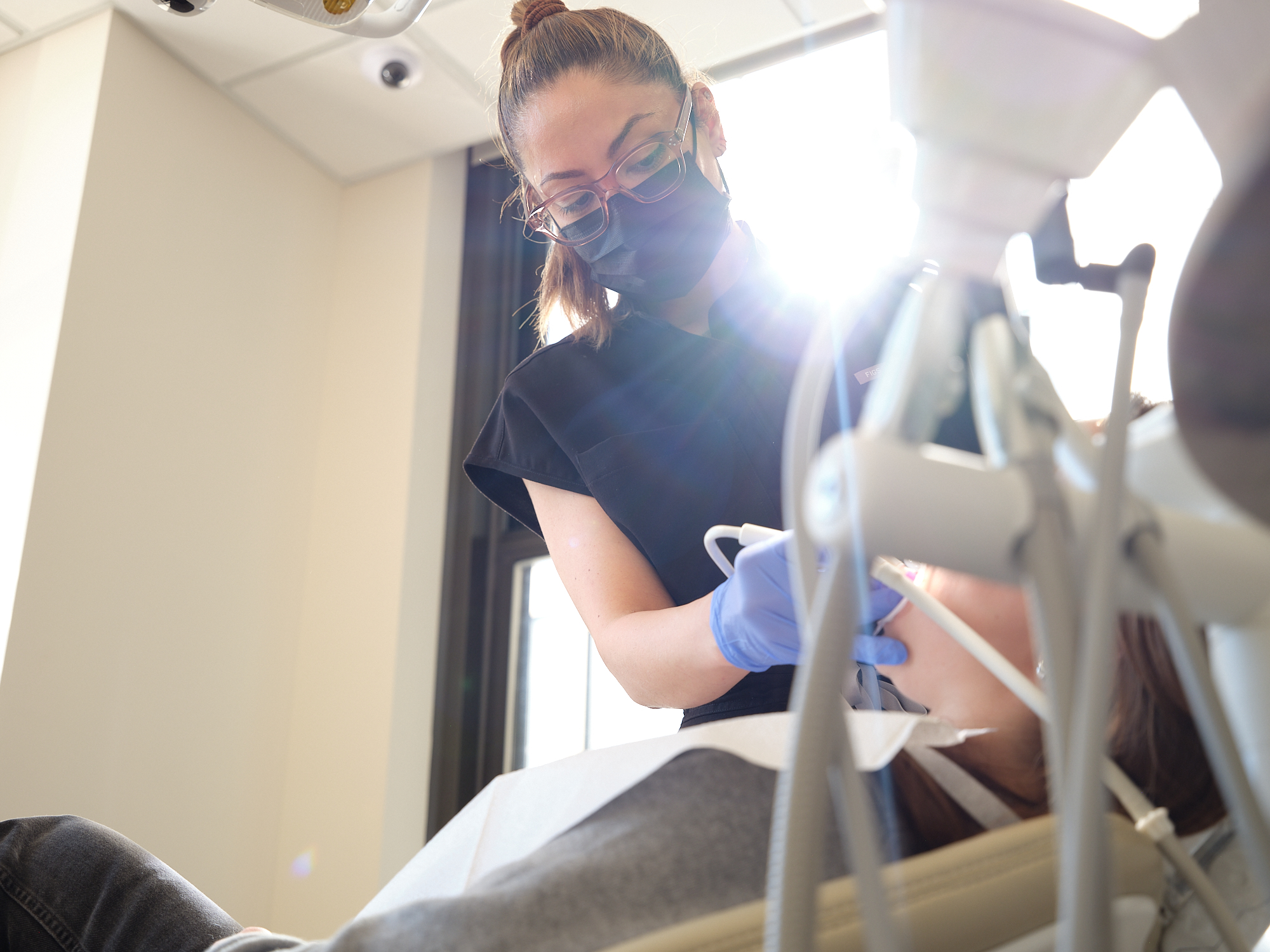

Had periodontal therapy at our practice?
Send an after-therapy check-in. It takes about two minutes, you can add photos, and our clinical team reads every one.
Send an after-therapy check-inPeriodontal Care Guide
Your Guide to Periodontal Care
A short guide to specialist gum care: what a visit involves, what to expect after deep periodontal therapy, and when to call us. No form required.
Request a periodontal care visit
The same number takes texts, message us and the office will reply.
Your visit
One quick step. We will call you back with times that fit.
Review before sending
Tap any section to jump back and change an answer.
Sent securely to our front office. Prefer to talk? (718) 643-1953